 Understanding Resource Guarding: Why Dogs Guard Their Possessions
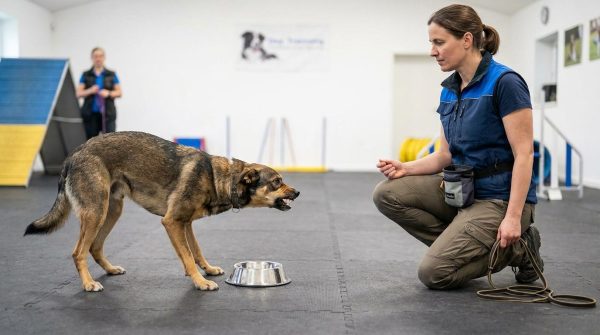
Your dog has a bone. You approach. They stiffen, growl, and snap at your hand. You back away. This is resource guarding—a dog’s attempt to control who has access to something they’ve decided is valuable.
Resource guarding is rooted in survival instinct. In the wild, access to food, safe resting places, and mates directly determined survival. A dog that didn’t guard valuable resources lost them—and in ancestral terms, that meant starvation. This instinct is hardwired, though it expresses itself differently in domestic dogs depending on individual temperament, history, and training.
What’s important to understand: resource guarding is not a sign your dog is “bad” or “dominant.” It’s a learned behavior reinforced by success. When a dog growls and you back away, the dog learns “growling works—it gets me space from my resource.” This learning happens quickly, which means the behavior can also be unlearned quickly with proper behavior modification training.
Resource guarding is extremely trainable, but it requires a different approach than typical obedience training. The goal isn’t forcing your dog to tolerate proximity to their guarded items—it’s changing their emotional response to that proximity.
Common Guarded Resources and Resource Guarding Triggers
Food guarding is the most common type. A dog controls access to their bowl, bones, or food they find outside. Some dogs guard only when eating. Others guard food hours after finishing their meal—the bowl itself represents a resource even when empty.
Toy guarding involves control over toys, chew items, or other playthings. A dog might be fine with you picking up a tennis ball but aggressive if you approach a Kong. The value of the resource—real or imagined—determines guarding intensity.
Space guarding is control over a location: a favorite sleeping spot, a crate, or an area of the couch. You approaching the dog’s spot triggers guarding behavior, even though they’re not eating or playing with anything.
Person guarding occurs when a dog guards their handler or a family member from other people or dogs. They block access, growl when others approach, or snap at people reaching toward their person. This is sometimes called “guarding the social resource.”
Toy/item guarding from other dogs causes conflict in multi-dog households. One dog guards toys or bones specifically from their housemates, not from humans. This can escalate into serious fights if not managed.
The value of the guarded resource often doesn’t match human logic. A low-value toy might trigger intense guarding while high-value items don’t. This is because the dog’s perception of value is subjective and learned. Through training, you can reshape what your dog perceives as valuable enough to guard.
Early Warning Signs: How to Spot Guarding Before It Escalates
Resource guarding escalates gradually, and recognizing early warning signs prevents it from becoming dangerous.
Level 1: Stiffening around the resource Your dog goes rigid when you approach. Their body tightens, muscles tense, and movement stops. This is the earliest warning sign—your dog is becoming alert about the resource.
Level 2: Increased eating speed Your dog gulps food rapidly when you’re nearby, as if trying to finish before you take it. This signals anxiety about your proximity to the resource.
Level 3: Positioning between you and the resource Your dog stands over the item, places their body between the item and you, or turns to face you while near the resource. Body language is tense, not playful.
Level 4: Growling An audible growl while you’re near the resource. This is a warning—your dog is communicating displeasure about your proximity and threatening to escalate if you get closer.
Level 5: Lip curling and baring teeth Combined with growling, your dog shows their teeth. This is a strong warning that a snap is coming.
Level 6: Snapping or biting Your dog lunges, snaps in the air, or makes contact with your hand. At this level, resource guarding is dangerous and requires immediate professional intervention.
Most resource guarding incidents can be prevented by intervening at levels 1-2, before vocalization begins. Once you notice stiffening or speed-eating around resources, training should begin immediately.
Why Resource Guarding Is Serious and Who Gets Hurt
Resource guarding becomes dangerous in specific scenarios. Understanding the risks helps you recognize when professional training isn’t optional.
Small children and resource-guarding dogs are incompatible. Young children don’t understand warnings. They approach a dog’s toy without recognizing warning signs. A resource-guarding dog, especially one who has learned that growling makes people back away, may bite rather than warn. This is the most common scenario leading to serious dog bites.
Guests create vulnerability. A guest doesn’t know which items your dog guards. They might absent-mindedly pick up a toy, reach for a bone, or sit on the couch where your dog was resting. Your dog, not recognizing the guest as “family,” may bite without the extended warning cycle they might give family members.
Veterinary or grooming emergencies become complicated. If your dog needs emergency care and a vet needs to handle their mouth or face, resource guarding creates safety risks. A dog that guards their space or person becomes unpredictable during medical handling.
Multi-dog households escalate quickly. Resource guarding between dogs can trigger serious fights over toys or bones. Even playful interactions can become dangerous if both dogs are guarding resources.
Escalation is common without training. Resource guarding rarely improves on its own. It typically worsens as the dog learns their guarding behavior is effective. A dog who growled at week one might bite at week four without intervention.
How Professional Training Rewires Resource Guarding Behavior
Desensitization for resource guarding works by changing your dog’s emotional response to your proximity to their resources. Instead of “your approach = threat = I must guard,” the dog learns “your approach = great things happen = I don’t need to guard.”
Phase 1: Approach and retreat Your dog has a valuable item (bone, Kong). You approach from a distance where your dog stays completely calm—maybe 10 feet away. You look at the item, then walk away. No touching, no taking. Repeat this 5-10 times daily. The goal is teaching your dog “a person approaching my item doesn’t mean I lose it.”
Phase 2: Closer approach Over days and weeks, you approach incrementally closer. Maybe day one is 10 feet, day three is 8 feet, day five is 6 feet. Your dog stays calm because this has been predictable and non-threatening. You’re literally conditioning them to be calm as you get closer.
Phase 3: Near proximity with rewards Once you can stand right next to your dog while they have their resource without any guarding behavior, you add rewards. Your dog has the item. You stand near them. You drop a treat next to them. Repeat: standing near + good things happen = calm behavior around resource.
Phase 4: You touch the resource You gently touch the item your dog is guarding—a bone, toy, whatever. The moment you touch it, good things happen: treats, praise, the item being returned. This teaches “someone touching my item = I get even better things in return.”
Phase 5: You take the item and return it Final phase: you take the guarded item, hold it for a moment, and return it immediately. Your dog learns there’s zero risk in losing the item—it always comes back, and usually with something better.
This entire process typically takes 6-12 weeks depending on the severity of guarding. Patience and consistency are critical. One mistake (rushing, punishing, or forcing) can reset progress significantly.
The Advantage of Intensive Training for Serious Cases
Self-directed desensitization works for mild to moderate resource guarding when owners can implement consistently. However, Board & Train programs offer distinct advantages for severe resource guarding or multi-dog situations.
Controlled environment: A trainer’s facility has no young children, no guests, and no multi-dog dynamics unless the trainer intentionally orchestrates them. Your dog practices new behavior without real-world complications.
Expert timing and progression: A trainer reads your dog’s emotional state and progresses at the ideal pace—neither too slow (boring repetition) nor too fast (triggering guarding). They know when to move to the next phase based on how your dog responds.
Intensive daily work: In a facility, your dog works on desensitization multiple times daily with varying items, people, and scenarios. This accelerates learning compared to once-daily home sessions.
Multi-dog dynamics: If your dog resource guards around other dogs, a Board & Train program can include supervised interactions with other dogs and items, teaching your dog that their resources aren’t threatened by canine presence.
Owner education built in: Trainers teach owners how to maintain and build on training after the dog comes home. You’re not just getting a trained dog—you’re getting the knowledge to prevent regression.
For severe resource guarding or cases involving young children, Board & Train often provides faster, safer progress than home training.
Keeping Everyone Safe While Behavior Changes
Resource guarding behavior change takes time. While training progresses, active management prevents bites and prevents your dog from practicing guarding behavior.
Remove guarded items during training phase: If your dog guards bones, don’t leave bones out. If they guard toys, pick up toys when not supervised training. You’re preventing your dog from reinforcing guarding behavior during unsupervised time.
Feed separately in multi-dog households: Feed dogs in separate areas, behind closed doors if needed. One dog eats while the other is in another room. This eliminates one major guarding trigger during training.
Manage access to high-value items: High-value items (expensive chews, special toys) should only be given during intentional training sessions with the trainer or under close supervision. Low-value items can be left out during non-training time.
Restrict guest access: During training phases, minimize guest visits or warn guests explicitly: “Do not approach the dog with toys, food, or gifts. Do not reach toward the dog. Do not sit where the dog is resting.” Clear boundaries prevent accidental guarding triggers.
Prevent small children from triggering guarding: If you have young children and a resource-guarding dog, supervise 100% of interactions. Children cannot approach the dog while they have food or toys. This isn’t permanent—it’s management during training. Once behavior improves, restrictions gradually relax.
Preventing Resource Guarding and Maintaining Improvements
Prevention is easier than treatment. Starting puppies with proper resource handling prevents guarding from developing in the first place.
Puppy practice: Approach your puppy while they eat. Give treats while they’re eating. Take their toy, play, return it. This teaches puppies from the start “people approaching my resources = good things, not threats.”
Post-training maintenance: Even after successful training, occasionally approach your dog during meals and add treats. Occasionally pick up toys during play and return them. These brief reminders maintain the trained behavior long-term.
Consistency matters forever: Don’t accidentally undo training by letting family members ignore the rules. If one person respects the dog’s boundaries during eating while another doesn’t, guarding behaviors can re-emerge.
Frequently Asked Questions About Resource Guarding
Can resource guarding be cured completely?
Most dogs can be trained to not guard resources with people. Their emotional response changes: proximity to their items stops triggering anxiety. However, the instinct doesn’t fully disappear—if training stops, guarding can re-emerge. This is why maintenance and consistency are important long-term.
What if I punish resource guarding? Won’t that fix it?
Punishment typically worsens resource guarding. A dog that gets punished for growling learns to skip the growl and bite without warning. You lose the communication that gives you a chance to prevent escalation. Punishment also increases the anxiety underlying the guarding. Desensitization, not punishment, is the evidence-based approach.
Should I take my dog’s toys away completely?
No. Removing all toys and resources can increase guarding intensity when your dog does have items—they become even more precious. Instead, manage access during training (remove unsupervised items) but provide items during supervised, intentional training sessions. This allows you to practice desensitization directly.
How long before I can leave a toy on the floor safely?
This depends on training progress. Early in training (week 1-2), pick up all toys after play. Mid-training (week 4-8), leave low-value items out but remove high-value items. Late in training (week 8+), your dog usually tolerates toys being left out without guarding. A trainer tells you when each phase is safe based on your specific dog’s progress.
Can I have a resource-guarding dog and children safely?
Yes, but it requires management and training. Until guarding is resolved, children cannot interact unsupervised with toys or food. During training and after, teach children to never approach the dog while they have items. Many families successfully manage this, and trained dogs become safe around children even if they previously guarded.
What if my dog guards space, not items?
Space guarding uses the same desensitization approach. You approach the space incrementally, reward calm behavior, gradually increase proximity. The principle is identical—changing emotional response to your proximity.
Resource Guarding Is Treatable—Get Professional Help
Resource guarding puts your family at risk and limits your dog’s safety and freedom. The good news is it’s one of the most responsive behavioral issues to professional training.
Behavior Modification training specifically targets resource guarding through desensitization protocols tailored to your dog’s triggers.
Board & Train provides intensive, controlled training that accelerates progress for severe guarding or multi-dog households.
Virtual Training gives you professional guidance implementing desensitization at home with real-time feedback and adjustments.
Contact Dog Busters today. Your dog’s resource guarding is fixable, and we can show you how.
Sources & Further Reading
- American Veterinary Society of Animal Behavior (AVSAB). (2024). “Resource Guarding Protocols and Prevention.” Retrieved from AVSABonline.org
- VCA Animal Hospitals. (2024). “Food Aggression and Resource Guarding in Dogs.” Retrieved from VCAhospitals.com
- Herron, M.E., et al. (2024). “Canine Resource Guarding: Behavioral Assessment and Training Interventions.” Retrieved from behavioral research journals