
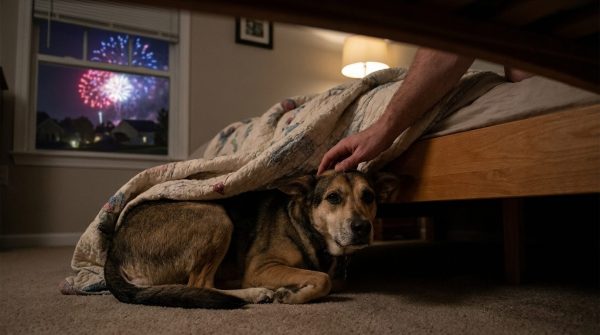
 When July 4th rolls around in San Diego, many dog owners dread the fireworks that will keep their pets up all night, panting, pacing, and terrified. Fireworks anxiety in dogs is more common than most pet owners realize — and it’s treatable. Dog Busters San Diego helps dogs overcome noise phobias and desensitizes them to the sounds that trigger their fear response, so your dog can face the season with confidence instead of panic.
Why Do Dogs Fear Fireworks?
Dogs don’t understand that fireworks are celebratory. To them, the sudden loud explosions are unpredictable threats, and their natural response is to flee, hide, or show signs of extreme distress. This fear isn’t something your dog will outgrow on his own — untreated fireworks anxiety often gets worse year after year.
Fireworks create a perfect storm for dog anxiety: they’re loud (sometimes 150+ decibels), unexpected, impossible to predict, and they repeat over several nights. A dog’s hearing is roughly four times more sensitive than a human’s, which means what sounds merely loud to you feels overwhelming to your dog. Some dogs will try to escape through windows, doors, or fences; others will hide, tremble, or refuse to eat.
VCA Animal Hospitals notes that fear of fireworks is a genuine phobia that triggers a stress response in your dog’s nervous system. Left unaddressed, noise anxiety can lead to destructive behavior, self-injury, and even escape attempts that put your dog in danger.
Signs Your Dog Has Fireworks Anxiety
Dog anxiety shows up in many ways. Your dog might pace restlessly, pant heavily, drool excessively, or bark and whine for hours. Some dogs become glued to their owner’s side; others hide in bathrooms or closets and refuse to come out. A few dogs will become aggressive or snap if you try to comfort them during their panic state.
Fireworks anxiety isn’t about being “bad” or “weak.” It’s a neurological response to a perceived threat. The more times a dog experiences fireworks without a way to feel safe, the more ingrained the fear becomes. This is why waiting it out or hoping your dog will adjust on his own rarely works.
How Professional Training Addresses Fireworks Anxiety
The gold standard for treating noise phobias is systematic desensitization and counterconditioning (DSCC), a behavioral technique that retrains your dog’s emotional response to the sound. Here’s how it works:
- A trainer plays a very quiet recording of fireworks sounds—so quiet your dog doesn’t react to it.
- While the sound plays, your dog receives high-value treats or praise, creating a positive association.
- Over days and weeks, the volume is gradually increased, always staying just below the threshold where your dog becomes anxious.
- Your dog learns: fireworks = good things happen, not danger.
This technique works because it doesn’t force your dog to “face” the fear all at once. Instead, it rebuilds the neural pathways so your dog’s brain stops interpreting the sound as a threat. Research from the American Veterinary Society of Animal Behavior shows that behavior modification combined with professional guidance was effective for dog owners managing fireworks anxiety.
The key to success is working with someone qualified to pace the exposure correctly. If the volume increases too fast or the pressure is too high, the training backfires and increases fear instead of reducing it. Dog Busters’ behavior modification programs are designed to address exactly this type of situational anxiety in your home, where your dog actually lives.
Virtual Training for Fireworks Season Prep
If your dog’s anxiety is manageable but you want expert guidance without committing to a full board-and-train program, virtual training offers real-time coaching as you work through desensitization. A trainer can watch your dog’s body language on video, tell you when to increase the volume, adjust your technique, and answer questions the moment they come up.
Virtual sessions are especially useful during the weeks leading up to July 4th, giving you a roadmap for managing your dog’s anxiety while staying in your own home where the real fear happens.
Intensive Solutions: Board and Train Programs
For dogs with severe fireworks phobias or dogs where the owner’s schedule doesn’t allow time for daily training, Dog Busters’ board-and-train program provides 24/7 professional behavior modification in a real home environment. This intensive approach allows trainers to:
- Work with your dog multiple times per day on desensitization.
- Identify and address co-occurring anxiety issues (separation anxiety, reactivity, etc.).
- Build confidence through real-world exposure and practice.
- Transfer the training back to you so you can maintain the progress at home.
A residential program compresses months of work into weeks, and your dog learns in the actual environment where he needs to succeed — your house, your yard, your neighborhood — not in a clinic or kennel.
Creating a Safe Space During Fireworks
While you’re working with a trainer on long-term desensitization, the ASPCA recommends creating a safe, calm interior room where your dog can retreat during fireworks. Close windows and curtains, play soft music to mask the sound, and make sure your dog has water and familiar toys. Avoid restraining or punishing your dog — both will increase anxiety.
ID tags and microchipping are also essential. In panic mode, even well-trained dogs will escape if they see an opening. Thousands of dogs go missing during fireworks season.
Frequently Asked Questions
How long does it take to desensitize a dog to fireworks?
Typically, systematic desensitization takes 4–12 weeks, depending on how severe the anxiety is and how consistently you practice. Some dogs show improvement within days; others need longer. A qualified trainer can assess your dog and give you a realistic timeline.
Will medication help my dog’s fireworks anxiety?
Medication can be part of the solution, especially for severe cases. Your veterinarian may prescribe anti-anxiety medication to reduce the panic response while training is underway. Medication alone, without behavior modification, rarely solves the underlying problem — but combined with desensitization, it can accelerate progress.
My dog panicked during past fireworks. Is it too late to train him?
No. Past panic doesn’t make training impossible; it just means the fear pathway is well-established. Desensitization still works because you’re retraining the brain’s response. The longer the anxiety has been present, the more patience and consistency training requires — but dogs of any age can learn.
Can I do desensitization on my own?
You can, but professional guidance is strongly recommended. The pace matters tremendously. If you move too fast, you’ll set training back weeks. A trainer ensures you’re reading your dog’s body language correctly and adjusting at the right speed.
Start Training Before Fireworks Season
The time to address fireworks anxiety is now — before July 4th arrives. Dogs that start desensitization training in May or early June have the whole month to build confidence before the actual fireworks begin. Waiting until the week before is too late to see real progress.
Schedule a behavior consultation with Dog Busters San Diego to discuss your dog’s anxiety and explore which training program — virtual coaching, in-home training, or board-and-train — fits your situation best. Your dog doesn’t have to suffer through fireworks season. Professional behavior modification gives him real relief.
Ready to Help Your Dog Overcome Fireworks Anxiety?
Dog Busters offers behavior modification training tailored to your dog’s specific fears and your schedule. Whether you need virtual coaching, in-home sessions, or an intensive program, we’ll create a plan that works.
Schedule Your Behavior Consultation or call us at (760) 978-5513.